

Port of Tauranga describes its response to climate change in its annual Climate-related Disclosures report, first published in 2024 under new rules for NZX-listed companies:
Port of Tauranga CRD report FY2024
Port of Tauranga CRD report FY2025
The reports outline:
- Governance – oversight of the Port's response to climate change by the management team and Board of Directors
- Risk management – how the Port identifies, assesses and manages climate-related risk
- Strategy – the current and future impacts of climate change and the transition to a low-emissions economy (and what we are doing about them)
- Metrics and targets – the Port's current emissions inventory, its decarbonisation plan and targets
The Port has mapped its emissions inventory and assessed risks and opportunities across its value chain:
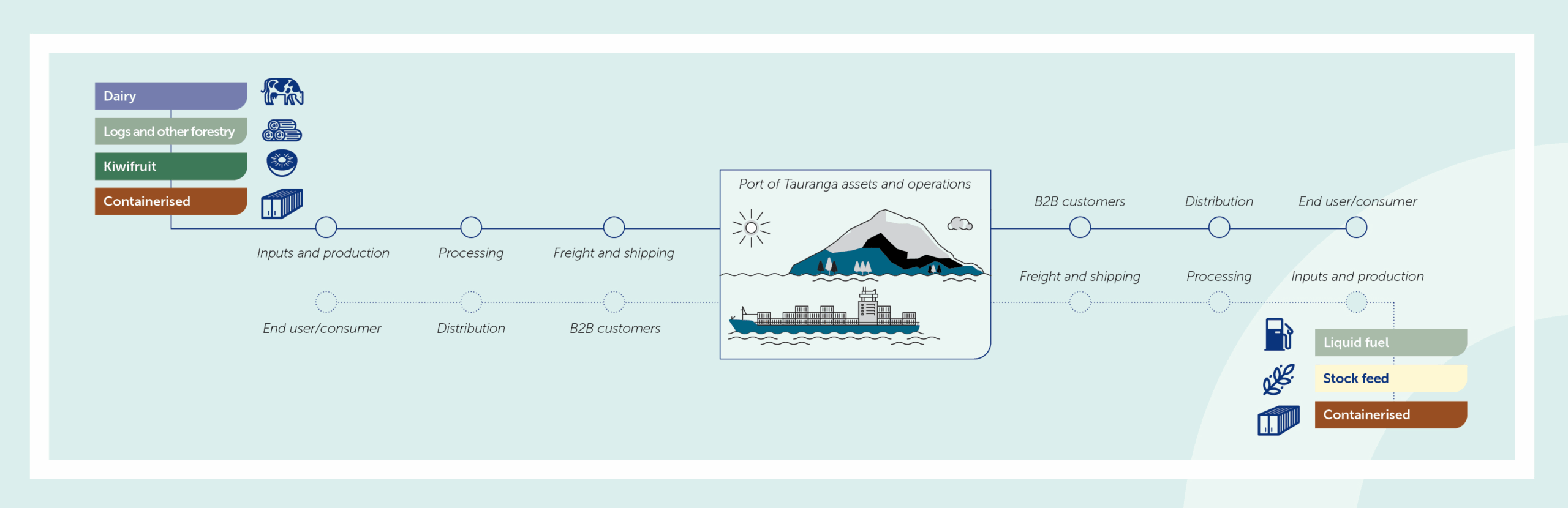
The Port has examined how it might perform under a range of potential futures, drawing on scenarios developed by the agricultural, transport and energy sectors:
- Orderly: global warming is kept to 1.4 degrees Celsius by 2100
- Disorderly: global warming is kept to 2.6 degrees Celsius by 2100
- Hothouse: global warming reaches 3.9 degrees Celsius by 2100.
Risks and opportunities
The climate-related risks and opportunities identified for Port of Tauranga include:
| Direct physical risks | Indirect physical risks (value chain) |
|---|---|
|
|
| Direct transition opportunities | Indirect transition opportunities (value chain) |
|---|---|
|
|
Metrics and targets
Absolute Scope 1 and 2 emissions for FY2025 were 21.9 kt CO₂e, up 20% from FY2024 (18.2 kt CO₂e) and up 15% from the FY2023 base year (19.1 kt CO₂e). The Scope 1 and 2 emissions intensity for FY2025 was 0.00084 t CO₂e per cargo tonne. This is a 13% increase compared to FY2024 (0.00074 t CO₂e) and a 12% increase compared to the FY2023 base year (0.00075kg CO₂e).
The increase in emissions for FY2025 can be attributed to two main things: a 32% increase in the Ministry for the Environment's location-based electricity emissions factor for FY2025 (due to an increased reliance on fossil fuels), and a 126% increase in diesel generator emissions at the Tauranga Container Terminal. Generators are used during peak periods when demand for refrigerated container power exceeds the capacity of the existing electric plug-in infrastructure. The increase in demand was driven by strong export seasons for kiwifruit, meat and dairy. Refrigerated container volumes increased 19.6% compared to FY2024.
The Port has increased the number of plug-in points for FY2026. The Port's proposed automation project also caters for an increase in the number of connections for refrigerated containers.

